The Complete Beginner's Guide to Claude (2026)
By Claude Tutorial · Last updated September 7, 2026
You've probably already tried Claude. You asked it something, got back a few confident paragraphs of nothing in particular, and closed the tab wondering what the fuss was about. That's not a Claude AI problem, it's a habit almost every beginner shares, and this guide exists to fix it: what Claude actually is, when to reach for it over ChatGPT, how to write a prompt that works on the first try, and how to turn one request into an entire finished workflow.
What You'll Learn
You don't need to read this whole guide to know it's worth reading. Here's exactly what you'll walk away with:
Understand what Claude actually is, not just a one-line definition
Know when to reach for Claude over ChatGPT, and when it genuinely doesn't matter
Write prompts that get a usable answer on the first try, not the fifth
Chain Claude's output into a real, multi-part workflow
Understand Projects, Artifacts, Skills, and MCP without the jargon
Know exactly where to go next once you're through this page
Here's the shape of the journey ahead:
Getting Started
Try Claude immediately and see why the habit matters
Understanding Claude
What it is, how it compares, what it can't do
Practical Workflows
Real prompts, real mistakes, a real chained example
Going Further
Frameworks, and Claude for your specific profession
Continue Learning
FAQ, more guides, and exactly where to go next
Quick Start
Reading about a tool and using it are different things. Before any explanation, try Claude once, so everything after this is grounded in something you've actually seen rather than taken on faith.
- 1
Create an account
Go to claude.ai and sign up. It's quick, and everything in this Quick Start works from there.
- 2
Paste this prompt
Copy the prompt below exactly as written. It works with anything as the "document," so don't overthink it yet.
- 3
Upload a simple document
Any PDF, email, or text file on your computer works: a receipt, a lease, an old assignment. Attach it before sending.
- 4
Read the result
Notice that Claude answers using the actual content of your file, not a generic response. That's the entire point of this exercise.
Read the document I've attached and tell me, in three sentences, what it's actually about and who it seems to be written for.
”That's it. You've just seen Claude do something a plain search engine can't: read something specific to you and answer a specific question about it. Everything from here explains why that worked and how to get more out of it.
Note
If that felt useful, know it's just the first exercise. Claude Tutorial teaches this same progression, and dozens more like it, as short structured lessons with practice built in, in case you'd rather learn the rest of this step by step instead of in one sitting.
Why Learning Claude Matters Right Now
That quick exercise probably felt small. It isn't. The gap between someone who treats Claude like a search box and someone who treats it like a genuine working partner is one of the widest skill gaps in any office right now, and almost nobody has been taught which side of it they're on.
Most people's first real contact with AI is a single disappointing exchange: a vague question, a generic answer, and a quiet decision that "it's not that useful for my work." That reaction is understandable and almost always wrong. It usually means the tool was tested with a search-engine habit, not a Claude habit, and the two produce very different results from the exact same effort.
The skill worth building isn't "using AI." It's specific: giving Claude enough real context to do something a search engine structurally can't, hold your actual document, your actual constraints, and your actual goal in mind across a whole conversation, and correct it in plain language when the first answer misses. That skill transfers to research, writing, planning, analysis, and dozens of tasks you haven't thought to try yet, and it's the one thing this guide is actually teaching, underneath all the feature names.
Building that habit now, while most people are still stuck on the search-box one, pays off well beyond this one sitting. That's exactly why this guide exists: not to list features, but to help you learn Claude as one transferable skill.
What Is Claude?
Claude is an AI assistant made by Anthropic, a company founded in 2021 by a group of researchers focused specifically on building AI that's safe and genuinely useful, not just impressive in a demo. You'll often see it called "Claude AI," since that's how many people search for it, though Claude is the product's actual name. You talk to it the way you'd type a message to a well-read colleague: in plain language, through a chat window, at claude.ai or in a mobile app. That's the whole starting point: a conversation, not a search box.
What makes it different from a search engine is memory within a conversation. A search engine treats every query as a fresh, disconnected lookup. Claude holds the entire conversation in mind: a document you uploaded three messages ago, a constraint you mentioned once, a correction you made to an earlier draft.
A search engine answers questions. Claude works through them with you.
That's a small technical detail with a large practical consequence. It means you can work with Claude the way you'd work with a person, refining an answer instead of starting over every time.
Here's what that difference looks like in practice. Ask a search engine "how do I write a resignation letter" and you get ten generic templates to sift through yourself. Ask Claude the same thing, then describe your actual situation, two weeks' notice, staying on good terms, no next job lined up yet, and it drafts something specific to you, then adjusts the tone or length the moment you say so. The templates didn't get better. The interaction changed from a lookup into a conversation.
The problem Claude actually solves for most people isn't "answer my question." It's "help me get from a rough idea to a finished, usable piece of work faster than doing it alone." That could be a first draft of an email, a structured summary of a messy document, a first pass at a spreadsheet formula, or a sounding board for a decision you're stuck on. The raw material already exists in your head or your files; Claude helps you shape it.
Anthropic's stated mission is building AI systems that stay reliable and steerable as they become more capable, which shows up in small, practical ways day to day: Claude tends to ask clarifying questions rather than guess silently, and it's generally willing to say "I'm not sure" instead of inventing a confident-sounding answer. Neither is a guarantee, but both are part of why people who evaluate several AI tools for real work often settle on Claude for tasks where getting it wrong is costly: a contract, a financial summary, a piece of writing with their name on it.
In practice, people use Claude for writing and editing, research and summarization, working through code, planning, and increasingly, tasks specific to their own job (more on that later in this guide). It became widely used for a mix of reasons: strong performance on writing and reasoning tasks, a conversational style many people find less generic than competitors, and a growing set of features, Projects, Artifacts, and more, that go well beyond a simple chat box. You'll meet all of them shortly.
Claude vs. ChatGPT
Every "best AI" listicle will tell you one of these is definitively better. That claim doesn't survive contact with actual use. The honest answer is that the two are close in raw capability and differ in the details that matter for specific tasks. Here's the quick verdict, then the detail behind it.
Choose Claude if
- Tone and voice matter: client emails, personal writing, anything with your name on it
- You're working through a long document or a long, evolving conversation
- You want a coding assistant that works across a whole project, not one file
Choose ChatGPT if
- You specifically need native image or voice generation
- You're already deep into its plugin ecosystem for one workflow
- You want the largest set of third-party integrations today
| Area | Claude | ChatGPT |
|---|---|---|
| Writing style | Tends toward a more natural, less "AI-sounding" default voice | Tends toward a more structured, list-heavy default voice |
| Long documents and conversations | Comfortably handles very long uploads and extended threads | Also strong, though heavy users report more context drift over very long threads |
| Coding | Widely used for real, multi-file coding work through Claude Code | Also strong, with a larger third-party plugin ecosystem |
| Image generation | More limited native image generation | Broader native image and voice generation |
| Feature ecosystem | Smaller, growing fast: Projects, Artifacts, Skills, MCP | Larger today, with more third-party integrations |
Here's a concrete case. You're drafting a difficult email to a client about a missed deadline. Claude will typically ask what tone you want and hold that tone consistently across three or four rounds of edits. ChatGPT will get you there too, but testers more often report needing to re-specify tone partway through a long editing session. Neither failure is dramatic, but if you're doing this kind of editing daily, the difference compounds.
None of this means one is objectively better. It means the two are built around slightly different defaults, and the right choice depends on what you're actually doing. Plenty of people use both, one for writing and analysis, the other for image generation, and there's no real cost to that.
What Claude Can't Do (Yet)
A guide that only tells you what a tool is good at isn't trustworthy, it's marketing. Here's where Claude genuinely falls short, stated plainly.
It doesn't know anything after its training cutoff unless web search is explicitly turned on for that conversation
It can state something incorrect with complete confidence, especially on obscure facts, exact numbers, and citations
It doesn't remember anything from a separate, earlier conversation unless that context lives in a shared Project
It can't take real-world action on its own, sending an email, submitting a form, unless a tool has been explicitly connected that lets it
It performs worse on very niche, highly specialized knowledge than a genuine domain expert would
A concrete example: ask Claude for the current price of a stock or today's weather, and without web search enabled, it will either decline or, worse, produce a plausible-sounding but fabricated number.
Without web search enabled, illustrated
That's not a rare edge case, it's a predictable result of how the underlying model works, and expecting it is more useful than being surprised by it later.
None of this makes Claude unreliable for the kinds of tasks this guide covers. It means treating any specific fact, number, or citation Claude gives you as a claim to verify, not a settled answer, especially when the stakes of being wrong are real. The next section goes further: not just what Claude can't do, but when it isn't even the right tool to reach for in the first place.
Ready to master Claude?
Everything you've learned so far gives you the foundations.
If you'd rather learn by practicing than by reading, Claude Tutorial turns these same concepts into structured lessons, quizzes, and guided learning paths designed to help you build real confidence using Claude.
How you'll learn
Learn Claude one concept at a time through structured lessons, practical examples, quizzes and guided learning paths.
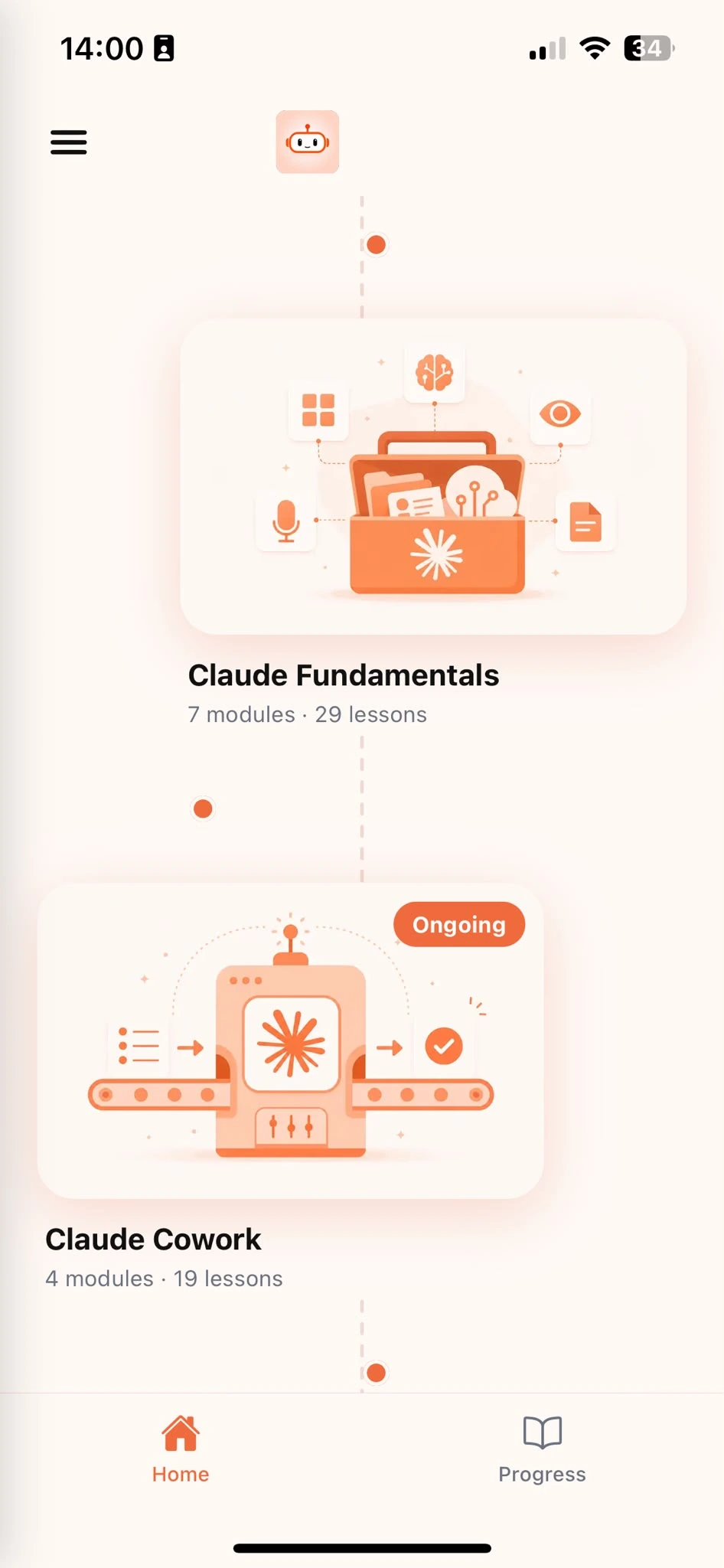
Browse Courses
Choose what to learn from a structured library of Claude lessons.
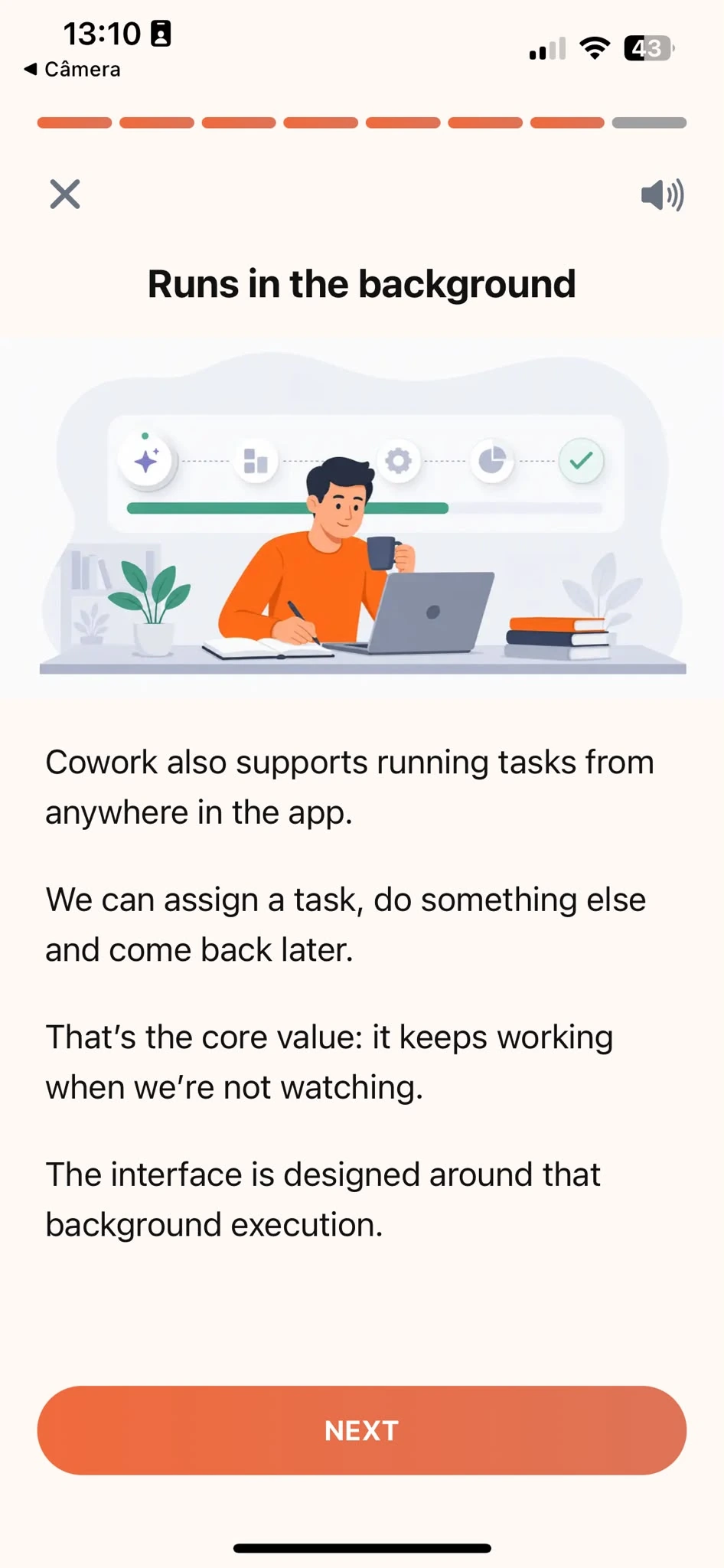
Learn
Short, focused lessons that build from fundamentals to real-world tasks.
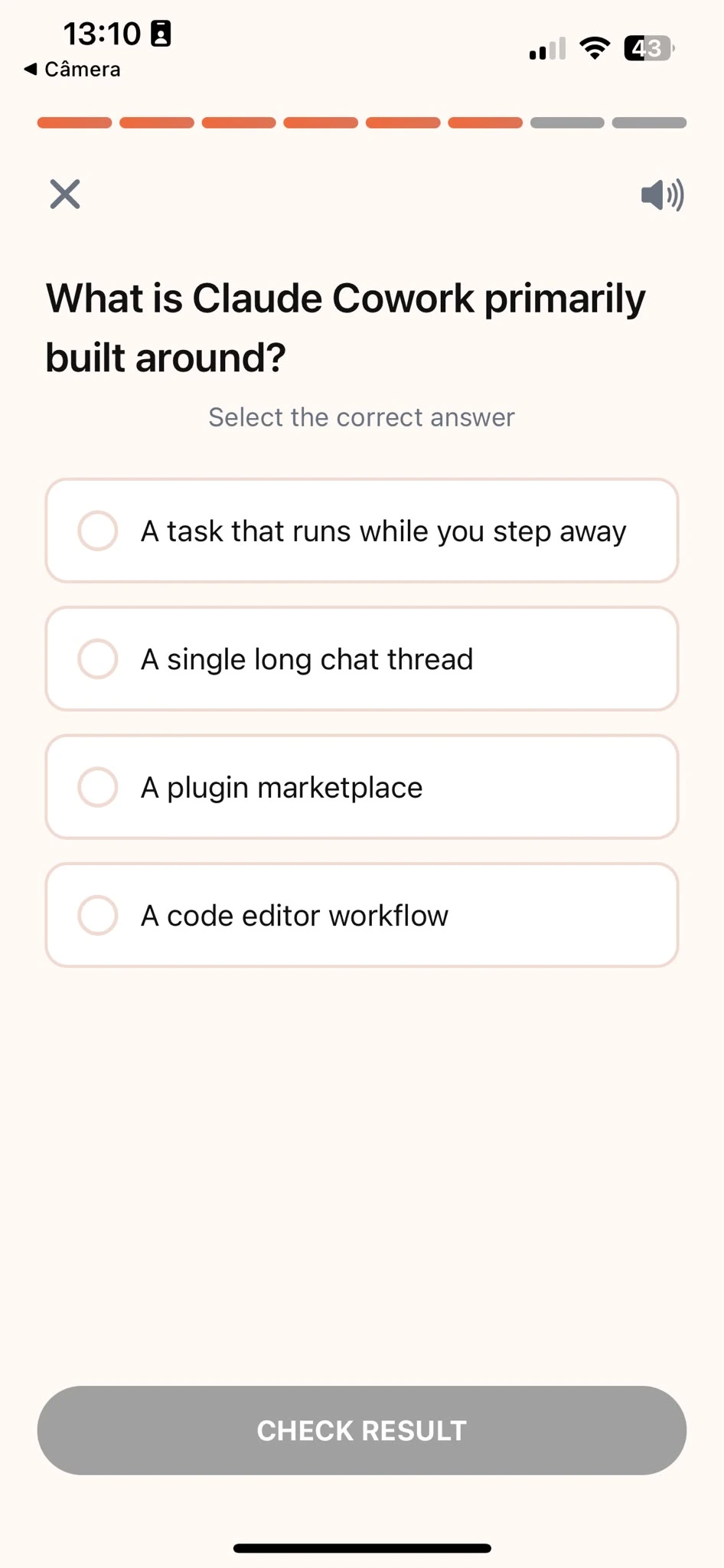
Quiz
Test your understanding right after each lesson, not at the end.
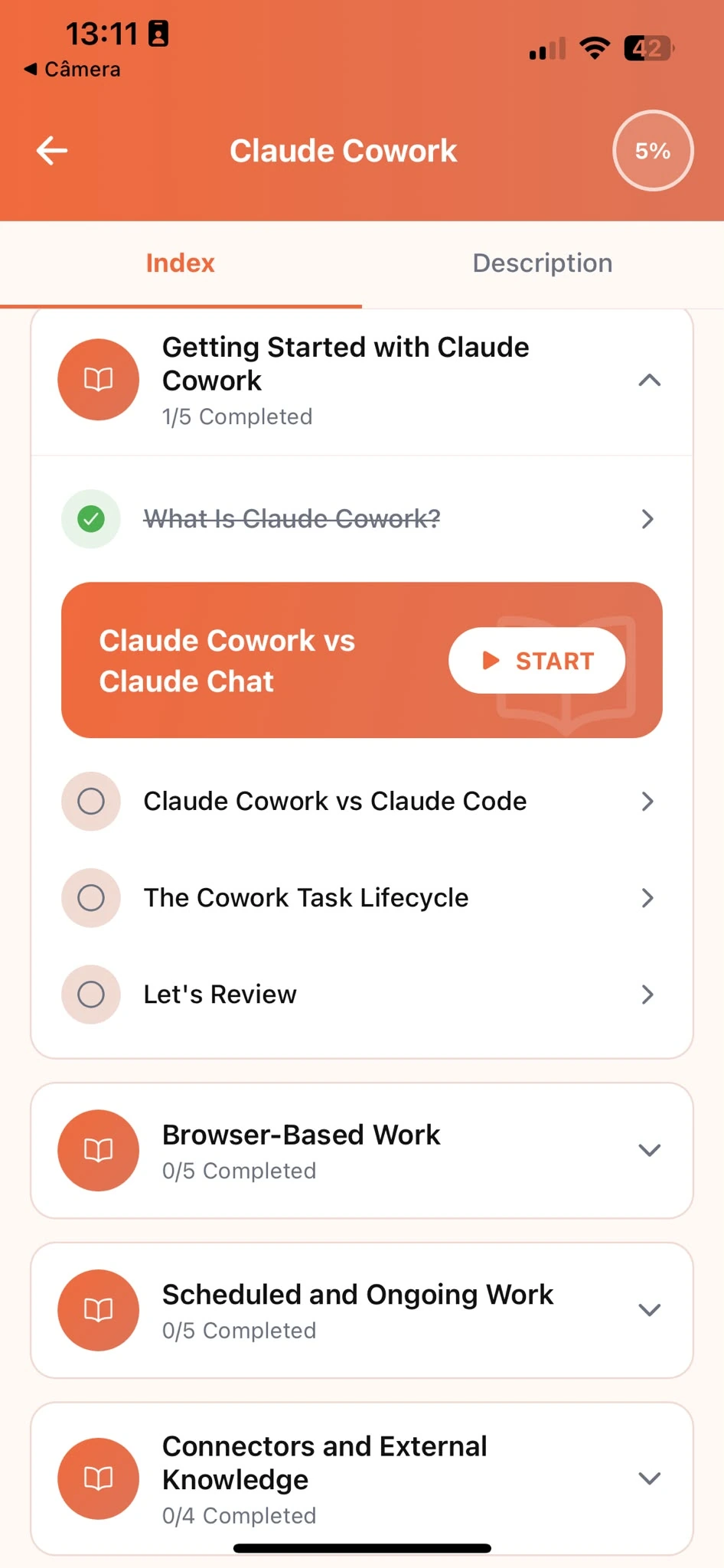
Track Progress
Pick up exactly where you left off, on any device, at any time.
How Claude Actually Works
Most explanations of Claude start with feature names, Projects, Artifacts, Skills, MCP, before explaining what any of them are actually for. That order teaches vocabulary, not understanding. Here's the reverse: five plain-language ideas first, then the names that go with them.
Claude remembers what's already in the conversation
Everything you've said, uploaded, or corrected earlier in the same chat stays available, so a fifth message can reference the first without you repeating it.
Claude works with documents, not just typed text
Upload a PDF, a spreadsheet, or a screenshot, and it can quote exact lines, compare files, or pull out just the section that matters.
Claude can generate more than chat replies
Ask for something substantial, a report, a simple interactive page, a chart, and it produces that as its own standalone piece to keep refining.
Claude can connect to tools and data outside the conversation
Rather than only working from what you paste in, it can reason over your actual, current files in a shared drive or a project tracker.
Claude can hold shared context across many conversations
A single chat's memory disappears when you start a new one. A dedicated space with persistent context doesn't.
Put together, those ideas form a natural escalation, from the simplest way of using Claude to the most capable:
A single conversation
SimplestEverything lives in one chat. No setup, and it already covers most of what this guide teaches.
A Project
PersistentShared context, files, and instructions carry across every new conversation inside it.
MCP-connected
Most capableClaude reasons over your actual, live data and tools, not just what you paste in.
Those five ideas have official names inside Claude, and once you know the idea, the name is easy to remember:
- The persistent, shared-context space from the fifth idea is called a Project. Read the complete guide to Claude Projects once you're ready to set one up.
- The standalone generated output from the third idea is called an Artifact. The practical introduction to Claude Artifacts covers exactly what's worth generating this way and what isn't.
- A saved, reusable way of teaching Claude to do a specific task your way is called a Skill. See putting your Claude skills together for how these compound over time.
- The connection to outside tools and data from the fourth idea runs on a standard called MCP (Model Context Protocol). Connecting Claude to your own data and tools with MCP is the approachable version of what's usually explained as a technical spec.
- The underlying model is just which version of Claude is answering. Different models trade speed against capability; the default is built for exactly the everyday tasks this guide covers, and you generally don't need to think about it further as a beginner.
Here's why the order matters in practice. Someone who learns "Projects" as a vocabulary word before understanding "shared context across conversations" as a problem often never uses the feature, it sounds like a settings screen, not a solution. Someone who's felt the friction of re-explaining their brand voice for the tenth time reaches for a Project immediately, because they already understand exactly what problem it solves.
None of these are required to get real value from Claude. A single well-used conversation, no Project, no Artifact, no MCP connection, already does most of what this guide teaches. They matter once you outgrow a single chat window, which for most people happens sooner than expected.
When Claude Is the Right Tool, and When It Isn't
Even within what Claude can technically do, it isn't always the best choice. Good judgment here is itself a skill, and it's one most guides skip, because "always use our tool" is an easier pitch than "sometimes don't."
Reach for Claude when:
You're drafting something and a blank page is the obstacle: an email, a brief, an outline, a first pass at anything
You need to make sense of something messy: a pile of notes, a long document, a scattered set of customer complaints
You're thinking through a decision and want to stress-test your reasoning against a genuinely different perspective
You need the same piece of work reshaped for a different audience or format without redoing it from scratch
Reach for something else when:
You need a guaranteed-current fact or live number without web search explicitly turned on
The task has zero tolerance for a wrong answer and no human checks the output before it's acted on
A dedicated tool already does the job better: a spreadsheet for calculations, a real project tracker for deadlines
You need one certain, correct answer rather than a well-reasoned first attempt
The pattern underneath all of this: Claude is at its best as a thinking and drafting partner, and at its weakest anywhere a wrong, confident-sounding answer could cause real harm before a human catches it. Keep that distinction in mind and almost every other decision in this guide gets easier.
Your First Claude Conversation
Most people's first prompt looks something like "write me a resignation letter." It's not a bad instinct, it's just too little for Claude to work with, so it fills every gap with the safest, most generic choice available. Watch what happens as the same request gets more specific.
Bad
Too generic"Write me a resignation letter." No situation, no tone, no constraints.
Better
Getting thereAdds the real role, timeline, and relationship, but still guesses at tone.
Excellent
Ready to sendAdds a length limit and names exactly what to avoid, not just what to aim for.
Bad prompt: "Write me a resignation letter."
This produces something technically correct and completely generic, the kind of letter you'd find in the first search result. Claude has no idea who you are, why you're leaving, or what tone fits your situation, so it can't do anything but guess at the middle of the road.
Better prompt: "Write a resignation letter. I'm leaving my job as a marketing coordinator after two years, giving two weeks' notice, and staying on good terms with my manager."
This is a real improvement. Claude now knows the role, the timeline, and the relationship to preserve, so the letter reads like it's actually about your situation, not a template. It still doesn't know how you sound, though, so the phrasing might feel stiffer or warmer than you'd actually write.
Excellent prompt: "Write a resignation letter. I'm a marketing coordinator leaving after two years, giving two weeks' notice, staying on good terms. Keep it warm but brief, three short paragraphs at most, and avoid corporate phrases like 'moving on to new opportunities.'"
This version adds the two things that actually separate a good result from a great one: a length constraint, so Claude doesn't pad it out, and an explicit style note, including exactly what to avoid, not just what tone to use. That last part matters more than people expect. Telling Claude what not to do is often more useful than describing what you do want, since "warm" alone still describes hundreds of different possible tones.
The excellent prompt, illustrated
Tip
The gap between "bad" and "excellent" here isn't clever wording. It's three concrete additions: the real situation, a length limit, and a specific thing to avoid. That pattern works far beyond resignation letters.
Write a two-sentence away message for my work Slack for a five-day vacation with no email access. Professional but not stiff, and don't mention "recharging" or "unplugging."
”Once a draft is close, the conversation isn't over. Point at exactly what's off, "the second paragraph is too formal," not "make it better", and Claude has something concrete to fix. That single habit, precise feedback instead of a vague reaction, is worth more than any prompt template. For a deeper look at exactly this, see writing prompts that get you a usable first draft and how Claude actually thinks and why vague prompts fail.
The Biggest Beginner Mistakes
Every beginner makes some version of these. Recognizing them in advance saves the two or three frustrating conversations it usually takes to learn them the hard way.
Mistake 1: Treating it like a search engine
Typing a bare keyword phrase and expecting a tailored answer back. Claude isn't retrieving a pre-written page, it's generating a response from what you give it, so a one-word prompt gets a one-word-prompt's worth of context in return.
Mistake 2: Starting a new chat instead of correcting the current one
Getting an answer that's slightly off, then opening a fresh conversation and re-explaining everything from scratch. Claude already has the full context in the current chat; a specific correction there is faster than starting over.
Mistake 3: Accepting the first draft as final
The first response is a starting point, not the finished product. Claude improves through the same back-and-forth you'd have with a human editor, and skipping that back-and-forth is the single biggest reason people conclude "the output wasn't that good."
Mistake 4: Giving feedback that describes a feeling, not a fix
"This isn't quite right" tells Claude nothing actionable. "The second paragraph focuses on the feature, not the customer's problem" gives it something to actually change.
Mistake 5: Pasting in far more than the task needs
Dropping an entire 40-page document in when you only need Claude to check one section wastes context and often produces a vaguer answer, not a more thorough one. Paste what's relevant, then ask precisely.
Mistake 6: Trusting a confident answer on a topic you can't personally verify
Claude can state something incorrect with the exact same confidence as something correct. Treat any specific fact, number, or citation on an unfamiliar topic as a claim to check, not a settled answer. See knowing where Claude's answers need a second check for exactly which kinds of answers deserve that extra step.
If something still isn't working after fixing all six, the issue usually isn't the prompt anymore. See what to do when Claude won't do what you asked for what's left to try.
Your First Real Workflow: One Input, Many Outputs
The habits so far, better prompts, real feedback, are worth a lot on their own. Chained together, they're worth much more. Here's what a single messy input can become in one sitting, without retyping anything.
Say you just left a one-hour meeting with pages of scattered notes: half-formed decisions, a few action items, one important date, and a tangent about next quarter's budget that doesn't belong anywhere yet. Instead of manually turning that into a follow-up email, then a separate checklist, then a summary for someone who missed the call, hand the whole mess to Claude once and ask for all three.
Here are my raw notes from today's meeting: [paste notes]. From this, produce three things: a follow-up email to the team that leads with the two decisions we made, a checklist of action items with the owner's name next to each one, and a five-sentence summary for someone who missed the call entirely.
”Input
Messy meeting notes
Half-formed decisions, scattered action items, one key date
Follow-up email
Leads with the decisions made, not a chronological recap
Action-item checklist
Each item paired with an owner, ready to assign
Summary for absentees
Five sentences, no context assumed
Notice what happened there: one input, three genuinely different, immediately usable outputs, generated from a single conversation instead of three separate ones. That's the real leverage of working this way. The email doesn't need the checklist's format, and the summary doesn't need either one's, and you didn't have to manually reshape the same content three times to get all three right.
This compounds. The next time a similar meeting happens, you already have a working template for what to ask for, so the second time takes less specifying, not more. That's the difference between using Claude once and building a workflow you actually reuse: see building a Claude workflow you can reuse and turning raw notes into a clean list of action items for more on both pieces of this.
Prompting Frameworks and Templates
By now you've seen specific examples of strong prompts. Here are two reusable structures for building your own, so you're not starting from a blank page even when writing the prompt itself.
The Context-Task-Format framework. State the background Claude needs, the specific task, and the shape the answer should take, in that order. It works for almost anything:
Context: I manage a team of six and one person has been consistently missing deadlines for a month. Task: help me draft talking points for a direct but supportive conversation with them. Format: five bullet points, no more than one sentence each.
”The Role-Constraint framework. Give Claude a specific role to answer from, then name the hard limits on the output. The role shapes the thinking; the constraints shape the output:
Act as a skeptical editor reviewing this product description for a first-time customer who's never heard of us. Point out anywhere the language assumes knowledge they wouldn't have. Keep your feedback to four points, ranked by how much each one would confuse a new reader.
”Neither framework is a rigid formula to fill in word for word. They're a checklist for what a strong prompt usually contains, so when a result falls flat, you can check which piece was missing instead of guessing.
- Real context Claude couldn't otherwise know
- A specific task, not a vague request
A format or constraint that shapes the actual output
One more habit worth building early: showing Claude an example of what you want is often more effective than describing it in the abstract. If you have a past piece of writing, a report format, an email you liked, paste a sample and ask Claude to match its structure or tone. See using examples to show Claude exactly what you want and giving Claude a role worth following for the deeper version of both ideas introduced here, and getting sharper answers without writing longer prompts for what to do once brevity, not length, becomes the challenge.
Claude by Profession
Every profession above has slightly different beginner traps and slightly different first wins, which is exactly why generic advice about “using AI at work” tends to feel useless, and why learning Claude for your specific job works so much better: a marketer's biggest early mistake looks nothing like a lawyer's, and the prompt that changes everything for a teacher does nothing for someone in sales.
The Learning Paths below take the fundamentals from this guide, better prompts, real feedback, chaining outputs together, and apply them to the specific tasks you already do in your actual job. Each card names one realistic use case, the mistake beginners in that field make most often, and one concrete thing to try today, before you ever open the full path.
- Advanced
Claude for Builders
A structured course that teaches Claude fundamentals through real builder tasks: turning ideas into working prototypes, connecting Claude to your own tools and data, working across a real codebase, and calling Claude's API directly.
- Use case:
- Making a multi-file code change with Claude Code instead of one file at a time.
- Common mistake:
- Treating Claude Code like autocomplete instead of giving it the full context of the change you actually want.
- Try this:
- Describe the feature you're building and ask Claude Code to plan the change across files before writing any of it.
5 guidesStart learning - Beginner
Claude for Content Creators
A structured course that teaches Claude fundamentals through real content creation tasks: scripts, captions, content ideas, calendars, and repurposing across platforms.
- Use case:
- Turning one video into a week of repurposed content without it feeling like copy-pasted text.
- Common mistake:
- Posting the same caption everywhere instead of reshaping it to how each platform is actually used.
- Try this:
- Paste your video description and ask Claude to adapt it into a Shorts script, a caption, and a newsletter blurb.
5 guidesStart learning - Beginner
Claude for Entrepreneurs
A structured course that teaches Claude fundamentals through real entrepreneur tasks: pitches, investor updates, customer insights, and strategic decisions.
- Use case:
- Comparing a bootstrapped and a funded path for the same idea before committing to either.
- Common mistake:
- Asking which path is "better" instead of which tradeoffs actually matter for your specific situation.
- Try this:
- Describe your idea and runway, and ask Claude to lay out what each path would actually require of you.
5 guidesStart learning - Intermediate
Claude for Financial Planning
A structured course that teaches Claude fundamentals through real financial planning tasks: budgeting, spending analysis, comparing financial decisions, and communicating your numbers clearly, whether that's to your household or your board.
- Use case:
- Turning a batch of expenses into a categorized analysis you can actually act on.
- Common mistake:
- Handing over raw numbers with no context on what decision the analysis needs to support.
- Try this:
- Upload a spending export and ask Claude to categorize it and flag the three biggest changes from last month.
9 guidesStart learning - Beginner
Claude for HR
A structured course that teaches Claude fundamentals through real HR tasks: job descriptions, policy drafts, interview evaluations, and internal announcements.
- Use case:
- Turning a rough headcount request into a job description that attracts the right candidates.
- Common mistake:
- Copying a generic job description template instead of grounding it in what the role actually needs.
- Try this:
- Describe the role in plain language and ask Claude to draft a job description with specific, real requirements.
3 guidesStart learning - Intermediate
Claude for Lawyers
A structured course that teaches Claude fundamentals through real legal tasks: contract review, client correspondence, case research summaries, and memo drafting.
- Use case:
- Reviewing a contract for the clauses that actually create risk, not a generic summary.
- Common mistake:
- Asking Claude to "summarize this contract" instead of asking it to find specific clause types.
- Try this:
- Upload a contract and ask Claude to find every clause that lets the other party change terms unilaterally.
4 guidesStart learning - Beginner
Claude for Marketing
A structured course that teaches Claude fundamentals through real marketing tasks: copy, research, briefs, and content strategy.
- Use case:
- Turning a rough campaign idea into a one-page brief your creative team can act on immediately.
- Common mistake:
- Asking for "better marketing copy" with no audience, goal, or constraint, then settling for the first generic draft.
- Try this:
- Paste your campaign goal and ask Claude to structure it into audience, message, channels, and a launch date.
10 guidesStart learning - Intermediate
Claude for Product Managers
A structured course that teaches Claude fundamentals through real product management tasks: PRDs, user feedback synthesis, roadmap prioritization, and release communication.
- Use case:
- Turning a one-line feature request into a PRD your engineering team can actually build from.
- Common mistake:
- Writing a roadmap doc that lists what's shipping without explaining the tradeoffs behind the order.
- Try this:
- Paste a feature request and ask Claude to draft a PRD that names the open questions, not just a filled-in template.
5 guidesStart learning - Beginner
Claude for Productivity
A structured course that teaches Claude fundamentals through real productivity tasks: prioritizing your to-do list, turning meeting notes into action items, drafting email replies, and planning your week.
- Use case:
- Turning a messy to-do list into a plan you'll actually stick to this week.
- Common mistake:
- Asking Claude to prioritize a list with no sense of your real constraints or available hours.
- Try this:
- Paste your to-do list and your real available hours, then ask for a realistic day-by-day plan.
5 guidesStart learning - Beginner
Claude for Sales
A structured course that teaches Claude fundamentals through real sales tasks: outreach, follow-ups, call notes, objection handling, and proposals.
- Use case:
- Turning a messy discovery call into a one-page proposal a prospect actually reads.
- Common mistake:
- Sending a follow-up email that recaps the whole call instead of leading with the next step.
- Try this:
- Paste your call notes and ask Claude for a follow-up that opens with the single next action, not a recap.
6 guidesStart learning - Beginner
Claude for Teachers
A structured course that teaches Claude fundamentals through real teaching tasks: student feedback, lesson plans, assessment, and adapting explanations for every learner.
- Use case:
- Turning one lesson explanation into versions for both struggling and advanced students.
- Common mistake:
- Writing a lesson plan sized for the time you wish you had, not the time you actually have.
- Try this:
- Give Claude your topic and the exact minutes available, and ask for a plan that fits that window.
5 guidesStart learning
Inside Claude Tutorial
This guide teaches Claude. Claude Tutorial teaches everything else too.
Everything above works on its own, no app required. Claude Tutorial is a separate app that turns skills like these into structured lessons, quizzes, and progress tracking, alongside hundreds of other practical AI workflows and Learning Paths beyond just this one guide.
Frequently Asked Questions
Getting Started
What is Claude?
Claude, sometimes called Claude AI, is an AI assistant made by Anthropic. You talk to it in plain language, and it holds the whole conversation in mind rather than answering each message in isolation.
Is this Claude tutorial suitable for complete beginners?
Yes. This guide assumes zero prior experience with Claude or AI tools generally, and builds up from the fundamentals to more advanced features like Projects and MCP.
Is there a structured Claude course or training program for beginners?
Not an official one from Anthropic. This guide, together with Claude Tutorial's structured lessons, quizzes, and Learning Paths, works as the closest thing to one: the same fundamentals covered here, with guided practice built in.
Do I need to download anything to use Claude?
No. Claude works in any browser at claude.ai. Mobile and desktop apps exist too, but a browser is enough to do everything in this guide.
What's the difference between Claude and the Claude Tutorial app?
Claude is Anthropic's AI assistant. Claude Tutorial is a separate app that teaches you to use Claude well through structured lessons, quizzes, and practice, built by an independent team, not Anthropic.
Do I need any technical or AI experience to start?
No. Everything in this guide assumes zero prior experience with AI tools. If you can send a text message, you already have the only skill this requires.
Which Claude model should I use as a beginner?
Start with whatever model is selected by default. Claude typically offers a fast everyday option and a more capable one for harder tasks; the default is built for exactly the kind of first conversations this guide covers.
Can I use Claude on my phone?
Yes, through a mobile browser or a dedicated app. Everything in the Quick Start section above works identically on a phone.
Claude vs. Other AI Tools
Is Claude better than ChatGPT?
Neither is universally better. See the comparison earlier in this guide for where each genuinely has an edge; the honest answer depends on what you're using it for.
Can I use Claude and ChatGPT together?
Yes, plenty of people do. There's no lock-in or conflict between them; using both for different tasks is a completely normal workflow.
Does Claude have access to the internet?
It depends on the setting and plan. Claude can search the web when that capability is enabled, but you shouldn't assume every answer reflects today's information unless you've confirmed that's on.
Is Claude the same as Anthropic?
No. Anthropic is the company that builds Claude, the same way OpenAI builds ChatGPT. Claude is the product; Anthropic is who makes it.
Why do some people prefer Claude for writing specifically?
Many users find its default writing style less generic and easier to redirect through follow-up feedback. That's a real, common preference, though it's subjective, not a settled fact.
Prompting
Why does my first prompt never work well?
A short prompt gives Claude almost nothing to work with, so it fills the gaps with generic guesses. The fix is a more specific first message, not a cleverer one; see the Prompting section above.
Should I write long or short prompts?
As long as it needs to be to convey the audience, goal, and constraints, and no longer. A short prompt with real specifics beats a long one padded with filler.
Can I correct Claude if it gets something wrong?
Yes, and you should. Point at exactly what's wrong in your next message rather than starting a new conversation. Claude keeps the context, so a targeted fix is faster than starting over.
Does Claude remember previous conversations?
Not by default across separate chats. Within one conversation it remembers everything you've said; a Project can carry shared context across multiple conversations, which the How Claude Actually Works section above explains.
What's the difference between a prompt and a conversation?
A prompt is one message. A conversation is the whole back-and-forth, and it's almost always the conversation, not the first prompt, that gets you a genuinely useful answer.
Can I give Claude a role or persona to follow?
Yes. Telling Claude to respond as a specific kind of expert, a skeptical editor, a patient tutor, shapes its answers meaningfully, especially for feedback and review tasks.
Projects, Artifacts, Skills, and MCP
What is a Claude Project?
A workspace that holds shared context, files, and instructions across many conversations, so you stop re-explaining the same background every time. Covered in How Claude Actually Works above.
What is a Claude Artifact?
A standalone piece of content, a document, a mini web page, a chart, that Claude generates and you can keep iterating on, separate from the back-and-forth chat text.
What are Claude Skills?
Reusable instruction sets that teach Claude a specific way of doing a task, so you don't have to re-describe your process from scratch every time you need it.
What is MCP?
Model Context Protocol: a standard that lets Claude connect to outside tools and your own data sources, like a shared drive or a project tracker, instead of working only from what you paste in.
Do I need to understand MCP to use Claude well?
No. Most of what this guide teaches works without it. MCP matters once you want Claude connected to systems beyond a single conversation.
Can Claude work with PDFs and documents?
Yes. You can upload a document and ask specific questions against it, quote exact sections, or compare it with another file, rather than getting one generic summary.
Can Claude generate things other than text?
Yes, through Artifacts, Claude can produce interactive content like simple web pages, charts, and formatted documents, not just plain text replies.
Practical Use
Can Claude help with tasks specific to my job?
Yes. See the Claude by Profession section above for real examples across marketing, sales, HR, teaching, finance, law, and more.
What shouldn't I use Claude for?
Anything needing guaranteed real-time data, verified facts without your own check, or a high-stakes automated decision. See When Claude Is the Right Tool above.
How do I know if Claude's answer is accurate?
Treat confident-sounding answers on specialized or high-stakes topics as a draft to verify, not a settled fact, especially for anything involving numbers, citations, or legal and medical specifics.
What's the fastest way to actually get good at using Claude?
Consistent, short practice on real tasks beats reading more theory. That's the whole idea behind this guide's Quick Start and the app's structured lessons.
Do I need to know how to code to use Claude?
No. Everything in this guide, writing, research, planning, working with documents, requires no coding at all. Claude Code, mentioned briefly for technical readers, is a separate, optional use case.
Related Guides
This guide covers the fundamentals. These go deeper on specific tasks across every kind of work this site teaches, not only the topics linked inline above.
How to Write Better Marketing Copy With Claude
The drafting-and-feedback loop from this guide, applied to ad and email copy
Sharpen a Cold Email Before You Hit Send
Testing a real prompt against a bar before you hit send
How to Write Better Job Descriptions With Claude
The same specificity habit, applied to hiring
Categorize Expenses and Spot Outliers with AI
Turning raw numbers into something you can actually act on
How to Spot Risky Contract Clauses With Claude
Asking for specific clause types instead of a generic summary
Writing a Lesson Plan That Fits the Time You Actually Have
Fitting Claude's output to a real, fixed constraint
Writing a PRD From a One-Line Feature Request
Turning a one-line ask into a structured document
How to Sharpen a Video Hook Before You Film
Testing your own work against a real threshold, not a feeling
Writing an Investor Update That Actually Gets You Help
Writing something honest that still gets you what you need
How to Plan a Week You Can Actually Stick To
Turning the first-workflow habit into a weekly routine
How to Make Multi-File Changes With Claude Code
Where this guide's fundamentals lead for technical work
Getting Started With Claude: The Core Habits
The habits behind this guide, in their original, job-agnostic form
How to Organize Long Claude Conversations
What to do once a single conversation gets long and unwieldy
How to Share Claude Work With Your Team
Taking what you've learned here beyond your own conversations
You Know More Than You Did Before You Opened This Page
You've now done more to learn Claude than most people who've had it open in a tab for months. That's not a small thing, and it's worth sitting with for a second before you close this tab and go back to whatever you were doing.
Everything in this guide, the comparison, the mistakes, the workflow, the frameworks, points at one underlying idea. That idea doesn't change as new features ship. Whatever Claude looks like a year from now, giving it real context and correcting it like you would a capable colleague will still be what separates a flat result from a genuinely useful one.
Claude rewards specificity and conversation, and punishes vague, one-shot requests. Everything else in this guide is a variation on that one idea.
Reading this once won't make any of it automatic, though. These habits become real through repetition on your own work, not through remembering that you read about them. The next email you write, the next messy set of notes you're handed, the next contract or lesson plan or campaign brief on your desk, that's the actual practice.
If you want to keep building this deliberately rather than piecing it together from scattered posts and trial and error, that's exactly what Claude Tutorial is for: short, structured lessons and practice on real tasks, organized into paths for your specific kind of work, the natural next step after a beginner guide like this one. Start with Claude Essentials for the fundamentals in a guided sequence, jump to your profession's Learning Path if you already know what you're here for, or browse the full guide library to explore at your own pace.
However you continue, you're starting from a genuinely different place than where you began this page. That's the whole point of this guide, and it's yours now.
Editorial note: Claude Tutorial is an independent educational resource. It is not affiliated with, endorsed by, or sponsored by Anthropic, the company that makes Claude.